

the internet’s favorite personality trait: being different
how pick-me culture quietly evolved into pseudo-intellectualism and the performance of better taste

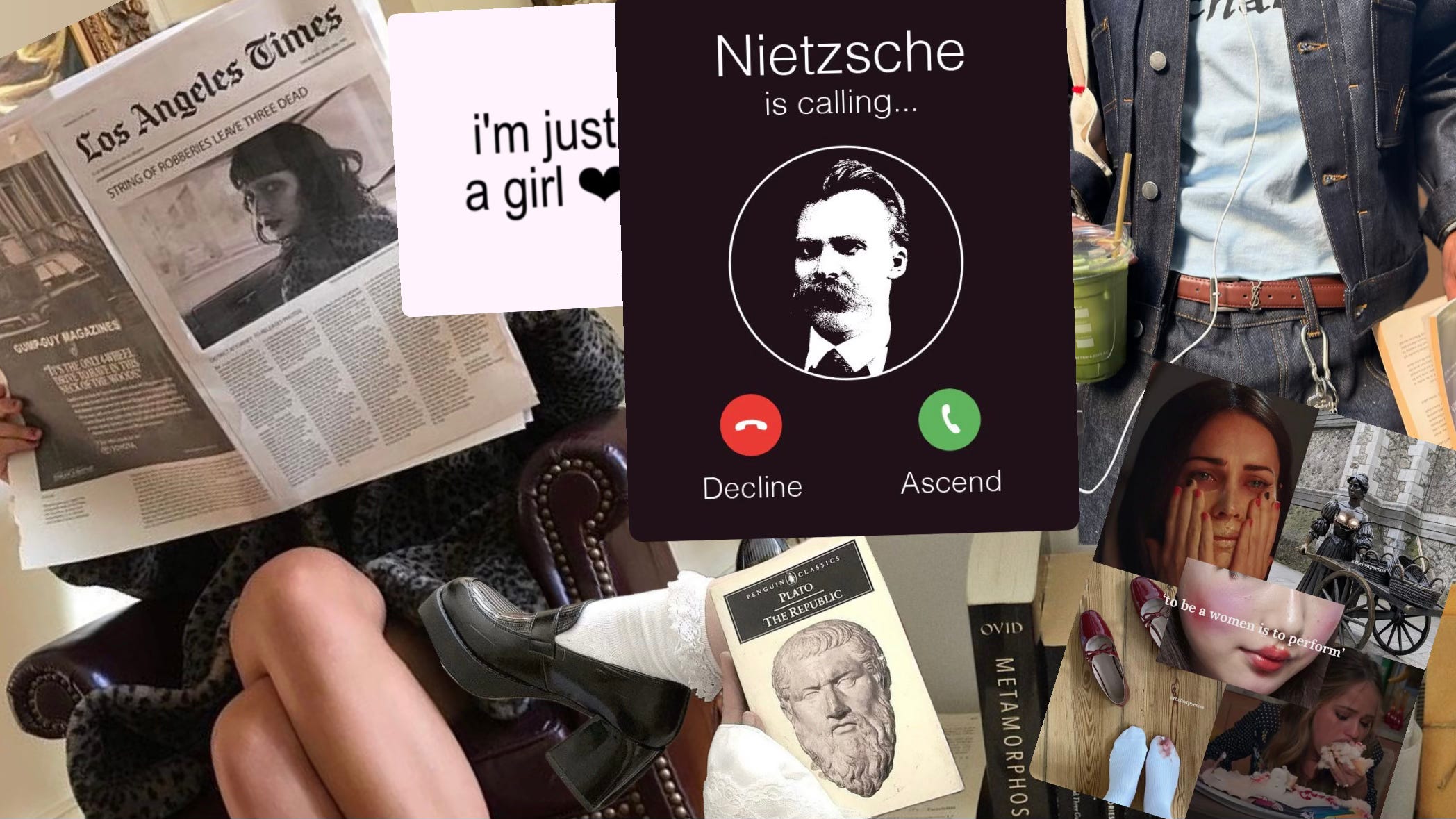
One thing I keep noticing online is how quickly people turn a small difference into a full identity. A taste, a preference, an opinion — and suddenly it becomes proof that they are fundamentally different from everyone else.
Lately it feels like pick-me culture has evolved into a new form. An intellectual one. Or more accurately, pseudo-intellectualism.
People constantly signal what they read, what music they listen to, what movies they watch or refuse to watch, how they dress or don’t dress — not because it’s a natural part of who they are, but because it helps construct a certain image. Especially the image of having better taste.
So someone says: I don’t read fantasy, I read Nietzsche.
Or: I listen to underground music.
Or: I don’t like movies everyone else likes.
A small difference from mainstream culture suddenly becomes their entire identity.
You can see this especially clearly in what people now call the performative male era. It almost feels like it replacing the whole “toxic aggressive male” archetype.
Now the performative male is different from other men. He carries a tote bag. He sits in a café reading feminist literature. (Actually reading? Or just holding the book? We all know the answer.) He drinks matcha. He wears wired headphones. He performs intellectualism. It’s just another way of saying: I’m not like other men. I’m more refined. More thoughtful. More intellectual. Even if he’s been staring at the same page for twenty minutes without turning it.
People are turning opinions into entire personalities. One single opinion becomes their whole identity.
You open the internet and see posts like this: a girl with beautiful hair writes, “I never blow-dry my hair, I never style it, it’s just naturally this healthy and beautiful.” The subtext is obvious: unlike all of you with your expensive Dyson stylers, I’m different. I’m natural. I don’t need an expensive tool for my hair to look amazing.
Or someone stops doing gel nails and suddenly that becomes a whole announcement. A story. A post. A comment under someone else’s post. Is quitting gel polish really such a life-changing event that the entire internet needs to hear about it?
Or take Taylor Swift. Everyone listens to Taylor Swift. I personally can’t stand her. Yes, I know, how original of me. But I’ve never thought of that as some defining trait of my personality. Why would I walk around telling people I dislike Taylor Swift?
Who the fuck cares?
But online every tiny preference turns into an identity statement. And the question is: why?
Is your identity really so empty that every minor difference has to be broadcast just so people notice that you’re not like everyone else? That you’re somehow smarter, deeper, more unique?
A perfect example of this happened with the release of the new Wuthering Heights adaptation. The film basically split the internet in half. One group loved it and called it another Emerald Fennell masterpiece. The other group immediately started attacking it.
And what exactly were they criticizing?
Suddenly everyone became a literary scholar.Apparently overnight. People started explaining how the film isn’t book-accurate — why Heathcliff should be a person of color, why generational trauma wasn’t portrayed enough.
Others turned into relationship psychologists, explaining that if you liked the movie you clearly need therapy, because the story portrays toxic relationships and obsession.
Then people started critiquing the costumes for not being historically accurate.
But fucking hell — if we’re going to criticize a film, then let’s at least treat it like what it actually is: a piece of art.
And if we’re discussing art, maybe we should start thinking critically first. Maybe watch or read an interview with the director. Maybe understand what the intention actually was.
Because the director and producers explicitly said this isn’t meant to be a literal adaptation. It’s an interpretation. They never intended to make historically accurate costumes. It was a stylistic choice.
So people are criticizing things the creators never even tried to do. Why? Because they have a different opinion and they just have to express it to everyone — even when it clearly lacks any real research.
And somewhere along the way people decided that art can’t just be art anymore. Apparently every film now has to teach us something, educate us, guide our moral behavior.
God forbid a film simply exists to create emotion, atmosphere, beauty.
Art doesn’t exist to teach you how to behave in relationships. It doesn’t exist to explain which men are red flags.
Sometimes we watch something simply for the experience. For the aesthetic. For the emotional depth.
I personally never watched that film thinking, “Oh my god, what a beautiful toxic relationship, I want that.” I saw it as a tragic story that was visually powerful and emotionally intense.
Sometimes art is just art. Not another opportunity to write a think piece about red flags.
So when did everyone suddenly become a psychologist? And when did it become normal to criticize things the creator never even attempted to portray?
Disagreement itself has become a kind of currency online. The fastest way to signal intelligence isn’t to understand something — it’s to reject it. To be the person who didn’t fall for the hype. The one who “saw through it.”
What’s actually happening here isn’t critical thinking. It’s the desire to stand out.
Everyone else loved the film. So now I have to hate it. And I have to say it loudly. Everywhere.
Because that proves I’m different.
Psychology actually explains this pretty well.
One mechanism is social identity theory — the idea that people construct their identity by distinguishing themselves from other groups. It creates a feeling of intellectual superiority.
There’s also the need for uniqueness, which is one of our basic psychological needs. People don’t want to dissolve into the mass. They want to feel different. So they start emphasizing those differences — sometimes artificially.
Another mechanism is identity signaling. People constantly signal to others who they are, what group they belong to, what status they have. And here taste becomes a social marker. Cultural capital. The books you read, the music you listen to, the films you watch.
But when people start carefully curating their tastes and opinions just to appear part of a “higher cultural class,” it becomes ridiculous.
Ironically, this whole attempt to stand out creates a new mass — a mass of pseudo-intellectual pick-mes. Performative intellectuals. Not just men, by the way. Women too, let’s just face it.
Everyone wants to be different, but everyone ends up performing the same curated uniqueness.
And the funniest part is how obvious it becomes. Suddenly everyone is talking about their whimsical lifestyle, their whimsical books, their whimsical outfits. Did everyone just learn the same new word?
So how do you tell the difference between real authenticity and pure performance?
It’s actually pretty simple. People who are genuinely authentic don’t constantly announce their tastes and differences. They read books because they enjoy them. They listen to music because they like it.
They don’t scream to the internet that they’re not like everyone else just because they stopped doing gel polish. They don’t tell others they’re not real fans because they discovered a band later. They don’t mock someone for reading Emily Henry instead of philosophy. They’re not trying to prove they’re different.
And the real question becomes: how do you keep your own authenticity in a world full of carefully curated identities?
Because when something that used to feel natural to you suddenly becomes a trend, it’s easy to lose confidence in your own taste. Easy to feel like you’re drowning in a sea of fake identities.
But we can’t control any of this. We can’t change the trend. We can only decide whether we participate in it or not. The only thing worth remembering is this: the moment difference becomes a performance, it stops being real.
When someone has to shout about how unique they are, that’s usually the first sign that the uniqueness was forced in the first place.
Curious what you think about all of this.
Feel free to share your thoughts in the comments.
Most of my texts are written under the influence of caffeine.
If you’d like to support the next one — you can do it here.
can i just say the film makers did NOT understand wuthering heights at all. i mean i personally didn't understand the heavy literature either but BABE that's not what was being told.
I find people like this all the time in TikTok comments, it’s SO infuriating and obnoxious like oh my gosh how lame do you have to be for you to have to shout about how cool and unique and “not lame like the rest of you losers” you are